

More Than a Golf Buddy: A Veteran and Volunteer’s 13-Year Connection

By Nickolas Sanchez, Public Affairs Officer, VA Eastern Colorado Health Care System
For 13 years, Army Veteran John Liska and volunteer Jeannie Hamilton have returned to the National Disabled Veterans Golf Clinic—not just as player and volunteer, but as “golf spouses.” Their partnership is built on familiar jokes, patient coaching, and a trust that makes navigating the golf course a reality again.
Liska, now 88, began golfing in his early 20s, long before macular degeneration took much of his vision. After enlisting in 1955, he served three years in the Army, training at Camp Chaffee, Arkansas, and spending time at Fort Knox, Kentucky, and Fort Ritchie, Maryland, before 17 months in Korea as an artillery repairman.
Decades later, vision loss forced him to reconsider the sport he loved. Legally blind, Liska tried to compensate by lifting his head early to track the ball, but it hurt his swing. “You want to see where that ball goes because you can’t see very well,” he said. “Then you start picking your head up, and everything deteriorates.” The answer, he learned, was to trust his body, his clubs, and his swing—and increasingly, Hamilton.
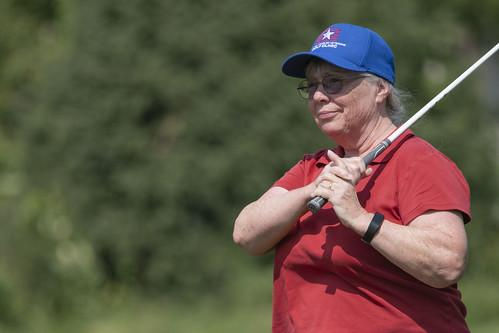
Hamilton, from West Branch, Iowa, has volunteered at the clinic for 30 years. She joined in 1993, when the event was much smaller and served only visually impaired Veterans. Over the years, she’s worked with golfers of all abilities, learning that each person needs a different kind of support. “Every year, I’ve learned stuff from it. The Veterans think that we give so much to them, but we get as much of it back,” she said.
Her approach with Liska is simple: keep him relaxed, steady, and focused. She places a white tee ahead of his ball for a visual guide, retrieves his clubs, and reminds him to slow his tempo.
Slow it down, John,” she tells him, and he responds with the easy rapport of someone who’s heard—and appreciated—the advice for more than a decade.
Their connection goes beyond the annual clinic. They check in throughout the year, and Hamilton has been a supportive listener as Liska navigates changes in his personal life. On the course, their conversation returns to golf: Was that shot pulled or pushed? Did he lift his head? Did the swing feel clean?
Liska may no longer see the ball drop into the cup, but he can hear it—and the sound brings back the old excitement. He returns each year for the camaraderie, the friendships, and the chance to be among people who understand. “Your life doesn’t end when the eyesight ends,” Liska said. “You’ve got to look for the good.”
For Hamilton, the clinic offers lasting rewards: reconnecting with old friends, meeting new people, and helping Veterans rediscover what they’re capable of. Liska hopes other Veterans facing vision loss will give the experience a chance. He encourages them to get outside, enjoy the sunlight, talk with others, and discover that losing sight doesn’t mean losing the opportunity for friendship, activity, or joy.
Hosted annually in eastern Iowa by DAV (Disabled American Veterans) and the Department of Veterans Affairs, the National Disabled Veterans Golf Clinic introduces Veterans with disabilities to adaptive golf, supporting rehabilitation, confidence, and camaraderie. For Liska and Hamilton, it has created something enduring: a friendship measured not only in clinics and years, but in every shared fairway, gentle correction, well-struck shot, and a forever off-course connection.


Comments